BOSTON, MA, 25th September, 2025 – The National Cancer Institute of Kenya (NCI-K) CEO, Dr. Elias Melly, participated in a three-day Global Health Catalyst Summit at Harvard University. Held from September 19 to 21, 2025, the summit provided a platform for international collaboration, bringing together top-notch minds from around the world to discuss innovations in global health and development. The event’s theme was “Catalyzing Win-Win Collaborations for Global Health and Development; Advancing Healthcare Outreach, Research, and Education Powered by AI.”
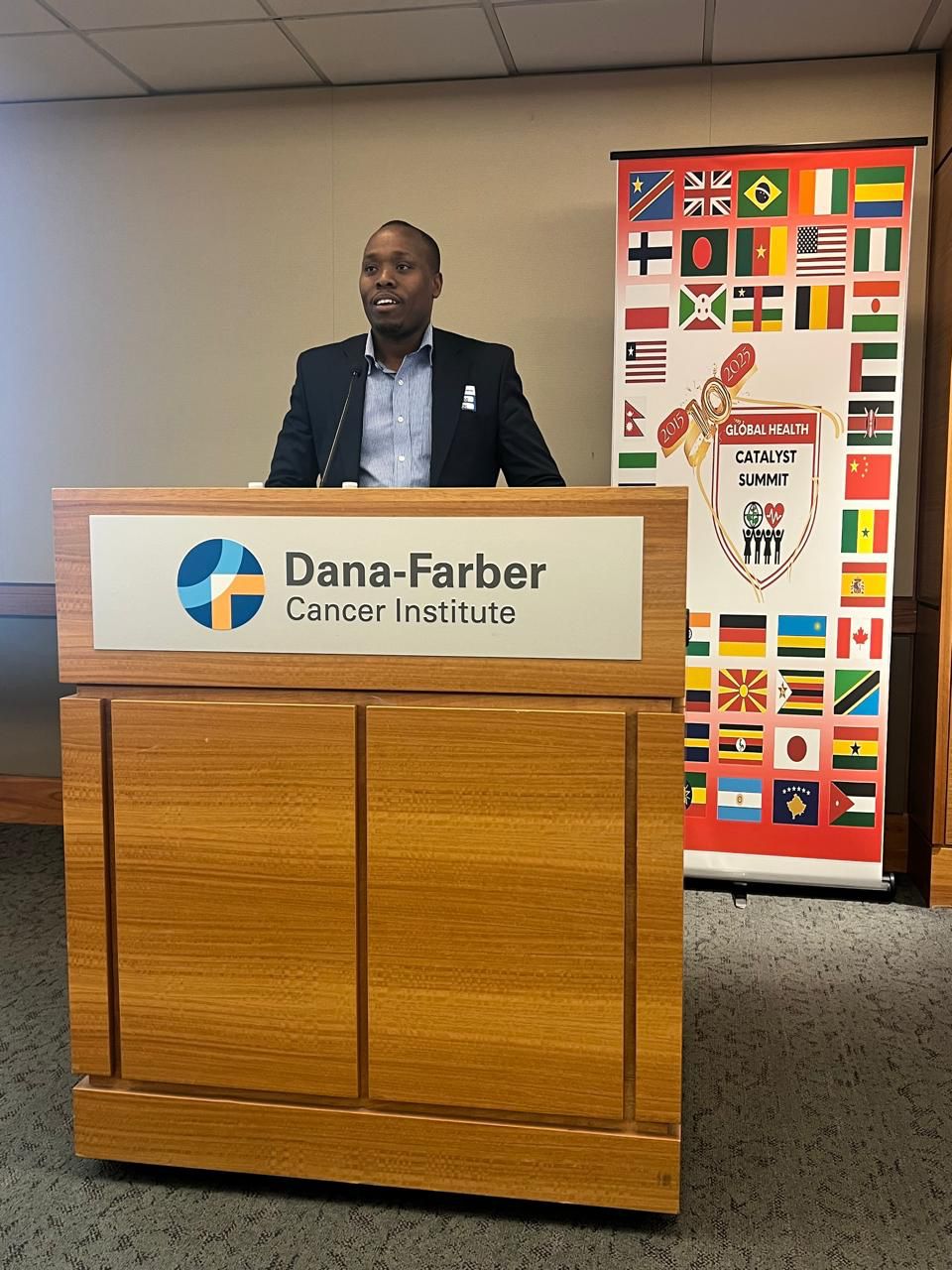
Dr. Melly’s presentation focused on a crucial aspect of modern cancer treatment: a cross-disciplinary approach that explores the synergy between Clinical and Surgical Oncology. His talk highlighted Kenya’s commitment to adopting cutting-edge solutions in the fight against cancer.
This event, organized by Harvard Zhu Family Center for Global Cancer Prevention and other partners drew together world Ministers, Institution Leaders, Industry, professionals from renown institutions and organizations including John Hopkins, University of Washington St Louis, Oxford University, International Atomic Energy Agency (IAEA), Union for International Cancer Control (UICC), AMSTRO, AAPM, AORTIC, Oncology Club, Leo Cancer Care USA, Diaspora and other C4 Stakeholders and many other renown institutions in the world.
The National Cancer Institute of Kenya leadership is actively building international and regional collaborations and partnerships that will make the fight against cancer significantly easier. As a regional leader in cancer treatment and management, Kenya’s efforts are a beacon for East Africa. With leaders from Kenya, Uganda, and Tanzania coming together for the sole purpose of uniting their efforts, the establishment of the East Africa Cancer Institute is now closer than ever.
A New Era of AI-Powered Cancer Care
With the world technological advancements, featuring AI, health is a matter of concern, with the cancer diagnostics and treatments being at the centre of discussion, this is why one Key event milestone characterizing this summit is the historic implementation of the World’s first AI-powered comprehensive cancer centre in the cloud (C4) – delivering world class comprehensive care, outreach, research and education across the globe. This milestone achievement is a collaborative effort between Harvard Zhu Family Center for Global Cancer Prevention, MIT Computer Science and Artificial Intelligence Laboratory, The Religion and Global Health Forum at Garrett, University of Massachusetts Lowell Medical Physics & Radiological Science, and Johns Hopkins CaREER program.
Presentations and discussions, from world-class professionals and experts, throughout the summit explored how AI can transform cancer care, with topics including:
- Win-win Collaborative Radiotherapy Innovations powered by AI
- Radiotherapy Reimagined: Can C4 and AI End the Cancer Divide by 2035?
- C4 win-win Collaborative Radiotherapy Research
- C4 Collaborative Radiotherapy Education
- C4 for Comprehensive Care & Advocacy/Outreach
- The Future of Cancer Prevention and Early Diagnostics
- Implementing the 2025 World Health Organization Resolution on Strengthening Medical Imaging Capacity
- C4 Cross-disciplinary Treatment: Clinical Oncology and Surgical Oncology
- C4 for Research and Education
A larger segment of time at this Summit was dedicated to showcasing innovations in cancer care, particularly those powered by technology. As discussed above, the presentations highlighted groundbreaking approaches, including how the C4 platform and AI can work together to end global cancer disparities by as early as 2035. Experts also explored how AI can optimize the coordination of multi-country clinical trials, including those for hypofractionated radiotherapy—a technique that can significantly increase patient access to treatment by reducing its duration. Additionally, sessions on cancer prevention and early detection underscored the importance of leveraging technology to improve public health outcomes.
Beyond technology, the summit focused on strengthening global partnerships and improving healthcare development through a variety of initiatives. Discussions covered topics such as the ASCO-Global Oncology Implementation Science (GO-IS) initiative, which focuses on applying research to improve cancer care in low- and middle-income countries. The C4 Collaborations Platform was presented as a way to facilitate partnerships between institutions in the United States and low- and middle-income countries for a wide range of needs, including oncology and palliative care. Other vital topics included global health finance, the role of the diaspora in health exchange, and fostering diversity and inclusion in clinical trial partnerships.
A Key takeaway from the summit was that the Global Health Catalyst Summit at Harvard presented a hub for world-class professionals and experts, where presentations and discussions explored a wide range of critical topics. These sessions were designed to catalyze international collaboration and leverage technology, particularly AI, to improve global health outcomes.
Leave a Reply