Category: Uncategorized

  • Meeting with H.E. Governor Dr. Wilber Ottichilo on Cancer Control Collaboration

    Meeting with H.E. Governor Dr. Wilber Ottichilo on Cancer Control Collaboration

    Mr. Chrisantus Wekesa, the National Cancer Institute of Kenya Capacity Building Officer, today, the 7th of May 2025, held a consultative meeting with H.E. Dr. Wilber Ottichilo, Governor of Vihiga County, to deliberate on strengthening cancer prevention and control efforts through devolution. Their discussions focused on establishing a collaborative framework between the National Cancer Institute of Kenya (NCI-K) and the County Government of Vihiga, in line with the National Cancer Control Strategy (2023–2027).

    H.E. the Governor expressed his commitment to supporting cancer control initiatives and pledged to champion the development of a structured partnership between NCI-K and Vihiga County. This collaboration will aim to enhance cancer awareness, early detection, timely referral, and access to quality cancer care services at the level.

    Later, Mr. Wekesa met with the County Health Management Team, led by Dr. Induswe Benjamin, in a discussion that focused on the five pillars of the National Cancer Control Strategy 2023-2027. The engagement further delved into the various achievements at both the County and National levels, and subsequently the existing gaps in cancer care and the necessary steps in addressing the issues as we gear towards a cancer-free nation.

  • Significant Boost to Oncology Funding Under SHA

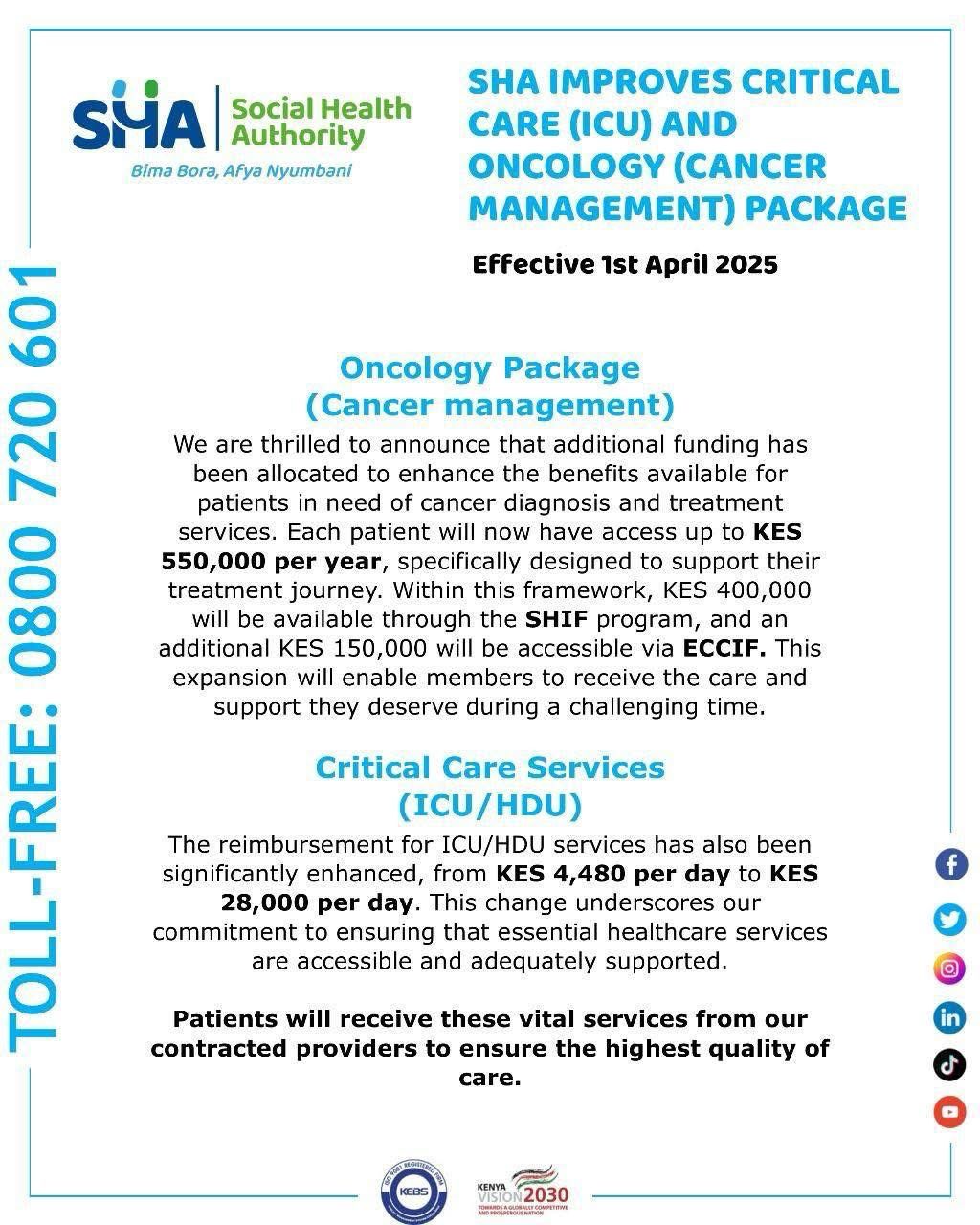
    There’s a significant advancement in Kenya’s healthcare system, particularly for individuals facing the challenges of cancer. The government, through the Social Health Authority (SHA), has made a crucial enhancement to the annual oncology (cancer management) package, now set at Ksh 550,000 per patient.

    This increased support, effective from April 1st, 2025, is structured to provide comprehensive financial assistance. Specifically, Ksh 400,000 will be accessible through the Social Health Insurance Fund (SHIF) program, with an additional Ksh 150,000 available through the Emergency, Critical and Chronic Illness Fund (ECCIF). This expansion is designed to ensure that members receive the necessary care and support during a difficult time.

    Furthermore, critical care services, including ICU and HDU, have also seen substantial improvement, with daily coverage increasing from Ksh 4,000 to Ksh 28,000. This adjustment highlights the government’s dedication to making essential healthcare services both accessible and adequately funded. In light of these advancements, the National Cancer Institute of Kenya strongly encourages all Kenyan citizens to register for the SHA, thereby securing their access to these vital medical care provisions.

  • Enhancing Esophageal Cancer Care in Kenya: Policy Recommendations

    Esophageal Cancer Awareness Month helps spread information about esophageal cancer. This type of cancer affects the esophagus, the tube that food travels through from the mouth to the stomach.

    Esophageal cancer happens when tumors grow anywhere along the esophagus, the muscular tube that leads from the mouth to the stomach.

    If this type of cancer is detected early, treatment may be effective and the outlook is better. But most people do not receive a diagnosis until esophageal cancer is in the later stages.

    Symptoms of Esophageal Cancer

    If you or someone you know is exhibiting symptoms of esophageal cancer, seek medical attention immediately.

    Symptoms include:

    • Difficulty in swallowing
    • Unintentional weight loss
    • Chest pain
    • Heart burn
    • Indigestion
    • Coughing
    • Hoarse voice

    This is to bring to the attention of all stakeholders and general members of the public that the Cabinet Secretary for the Ministry of Health, pursuant to section 36 of the Cancer Prevention and Control Act, No. 15 of 2012 has developed:

    1. The Cancer Prevention and Control (Standards of Care) Rules, 2023

    2. The Cancer Prevention and Control (Public Awareness and Education) Rules, 2023

    3. The Cancer Prevention and Control (Cancer Registries) Rules, 2023

    4. The Cancer Prevention and Control (Consent to Research) Rules, 2023

    5. The Cancer Prevention and Control (Inspection and Certification) Rules, 2023

    Under the Statutory Instruments Act, 2013, the National Cancer Institute of Kenya plans to engage members of the public and stakeholders on the same through public hearings. The purpose of the hearings shall be to get oral submissions on the draft Regulations to ensure that persons likely to be affected by the Statutory Instruments have adequate opportunity to give their views on the Instruments. The Draft Regulations can be obtained from the Institute’s website (The National Cancer Institute of Kenya – NCI Kenya)

  • Breast Cancer Awareness in LMICs: Raising Awareness & Improving Access to Care

    This month provides an opportunity for us all to focus on breast cancer and its impact on those affected by the disease in our community.

    The total breast cancer cases notified by county of usual residence between the years 2020 and 2023 amounted to 4,824 people in Kenya, Nairobi County leading with the highest number of diagnosed people at 550 followed by Nakuru County which registered 398 people.

    Finding breast cancer early provides the best chance of surviving the disease. While mammograms can help to detect cancer before you can feel a lump, breast self-exams help to be familiar with how your breasts look and feel so you can alert your doctor if there are any changes.

    Take the time to ‘get to know’ how your breasts normally look and feel through normal regular activities such as showering, getting dressed, using body lotion or looking in the mirror.

    You don’t need to use a special technique, but ensure you look at and feel your breasts regularly. Make sure this includes all parts of your breast, your armpit and up to your collarbone.

    For women of all ages, it is recommended that you be breast aware.

    Changes to look for include:

    • a new lump or lumpiness, especially if it’s only in one breast
    • a change in the size or shape of your breast
    • a change to the nipple, such as crusting, ulcer, redness or inversion
    • a nipple discharge that occurs without squeezing
    • a change in the skin of your breast such as redness or dimpling
    • An unusual pain that doesn’t go away.

    Visit a doctor in case you notice any changes in your breast.

    Breast cancer signs

    According to doctors, it is quite difficult for breast cancer to get diagnosed for women under 40 because their breasts are denser. This means that a tumour, if present, is not likely to show up in a mammogram.

    The most common way to detect breast cancer in younger women is to keep a close check on the changes in your breasts. In fact, according to Healthline, a majority of young women diagnosed with breast cancer discover an abnormality themselves. If you notice any changes in your breast, like changes in the skin, nipple discharge, pain, tenderness, or a lump or mass in the breast or underarm area, please report it immediately to a doctor.

    Breast cancer is one of the most common cancers in women and there is a misconception among people that it only happens to older women. While it’s true that most breast cancers are found in women who are 40 years or older, it is imperative to know that it can strike any female at any age.

    Pain in any Area of The Breast

    Check for pain and tenderness in any area of your breast. While lumps don’t usually hurt, some may cause a prickly sensation. However, pain in your breasts can also be due to numerous other benign reasons and hormonal changes. 

    Unusual Nipple Discharge

    An unusual nipple discharge that’s clear, red, brown, or yellow (other than breast milk) can be an early sign of breast cancer. If you notice this, consult a doctor for an evaluation.

    Breast Changes

    Look for changes in shape, swelling, and difference in size, texture, or temperature of either one or both breasts.

    Unexplained Redness/Rash

    Early warning signs of breast cancer can include unexplained redness, swelling, itchiness, or rash on one or both breasts.

    Swelling around the Collarbone or Armpit

    Consult your doctor if you notice swelling around your collarbone or under the arm. It could be a sign that the breast cancer has spread to the lymph nodes in that area.

    While these are some of the early signs of breast cancer, it is important to remember that these can also be caused by benign conditions. It’s always best to consult a doctor so that they can evaluate and help you determine whether it is cause for concern.

    Apart from this, it’s also important to keep in mind that often, women with breast cancer have no symptoms. This is why regular breast screening is important to detect it. The main tool to diagnose breast cancer is a mammogram, which basically shows normal and abnormal breast tissue.

    It is recommended that women should start getting mammograms when they cross the age of 40 and should continue getting one every 1 or 2 years. Meanwhile, for women above the age of 20, monthly breast self-examination is recommended.

  • Cervical Cancer Screening: Importance of Pap smear.

    A Pap test, sometimes referred to as a Pap smear, is a treatment used to detect cervical cancer in female patients.

    Cells from your cervix, which is the lower, thin end of your uterus that is at the top of your vagina, are collected for a Pap smear.

    You have a better chance of being cured if you have a Pap smear early enough to detect cervical cancer. A Pap smear can also find alterations in your cervical cells that point to the potential for cancer to arise in the future. Your first step in preventing the potential onset of cervical cancer is to have a Pap smear early to identify these abnormal cells.

    The Pap smear is usually done in conjunction with a pelvic exam. In women older than age 30, the Pap test may be combined with a test for human papillomavirus (HPV) — a common sexually transmitted infection that can cause cervical cancer. In some cases, the HPV test may be done instead of a Pap smear.

    Pap smears are crucial for women’s healthcare and offer a number of advantages, including:

    • Pap smears may detect cervical cell changes in your body that could turn into cancer if left untreated 
    • Pap smears can help find cervical cancer in its early stages, making it easier to treat
    • Pap smears allow for early detection which could mean less treatment and less recovery
    • Pap smears catch HPV that has been dormant. The HPV virus can be dormant for years and then suddenly become active so it is still important for all women to get Paps, regardless of age or sexual activity
    • Pap smears are extremely accurate and regular screenings can reduce cervical cancer rates and mortality by at least 80%
  • CURRENT CANCER TYPES THAT CAN BE SCREENED

    Cancer screening and testing is the process of checking your body for cancer when you have no symptoms or signs. The main purposes for cancer screening are:

    • Help prevent cancer deaths
    • Reduce the number of people developing disease
    • Helps the government for future planning in the fight against cancer

    Development of new cancer screening tests is now an actively cancer research area. Not all types of cancer can currently be screened. Currently, cancer screening is available for the following types of cancers.

    Breast cancer

    Skin cancer

    Lung cancer

    Cervical cancer

    Prostate cancer

    Head and neck cancers

    Colorectal cancer

    Screening Breast Cancer

    Breast cancer screening can be done through the following tests:

    Breast self-examination

    Mammography

    Clinical breasts examination

    Magnetic resonance images (MRI)

    Mammography is a special type of x-ray specifically designed to view the whole breast. The images produced during a mammogram can show tumors or other irregularities in the breast that cannot be felt during examinations or through other breast changes.

    When it comes to clinical-examination, a medical expert feels and looks for any changes in the breast’s size or shape when doing a clinical breast examination. The examiner also checks the nipples and breasts for changes in skin texture.

    Breast self-examination – The best technique to test for breast cancer at home is through self-examination. You examine and feel your own breasts to check for any changes during a breast self-examination. You should consult a doctor if you detect any changes.

    The routine detection of breast cancer does not include an MRI. But individuals who are at a higher risk of developing breast cancer, those who have dense breasts, or those who discover a lump during a breast exam might find it useful.

    Screening for Cervical Cancer

    The common tests used for screening cervical cancer include:

    1. Human Papillomavirus (HPV) test – The human papillomavirus (HPV) test identifies the presence of human papillomavirus, a virus which can lead to the growth of genital warts and abnormal cervical cells which can cause cervical cancer. Doctors may recommend the HPV test if:

    • One is age 30 and above
    • When the Pap test is abnormal, presenting a typical squamous cells of undetermined significance.

    Currently there is no HPV test for men, it is only available to women. Men can however still be infected with HPV and can transmit the virus to other women.

    2. Pap test – A Pap test, commonly known as a Pap smear, is a procedure a doctor uses to check for cervical cancer in female patients. Additionally, it may highlight changes in your cervical cells that could later develop into cancer. A Pap smear is done to look for changes in cervical cells before they turn into cancer, finding cell changes early can help prevent one from getting cancer.

    Screening for Colorectal Cancer

    There are many different ways for testing colorectal cancer including:

    Colonoscopy

    Colonoscopy is a test used to look for changes — such as irritated tissues, swollen polyps or cancer in the colon and rectum. During a colonoscopy, a long, flexible tube with a tiny video camera at the tip of the tube allows the doctor to view the inside of the entire colon. If necessary, polyps or other types of abnormal tissue can be removed through the scope during a colonoscopy. Tissue samples (biopsies) can be taken during a colonoscopy as well.

    Sigmoidoscopy

    A sigmoidoscopy, also called a flexible sigmoidoscopy, is a procedure that lets your doctor look inside your sigmoid colon by using a flexible tube with a light on it. It helps your doctor check for abnormal cells and polyps. Typically, pieces of tissue will be taken as samples to check for any abnormal cell changes.

    Fecal occult blood test (FOBT)

    Fecal occult blood test (FOBT) is a test that checks for occult or hidden blood in the stool. A small sample of stool is placed in a special collecting tube and submitted to a doctor or laboratory for examination. Blood in the stool could indicate colon cancer or other issues such as polyps, ulcers, or haemorrhoids.

    CT Colonography

    Computed tomographic (CT) colonography, also called CTC, virtual colonoscopy (VC) or CT pneumocolon, is a powerful minimally invasive technique for colorectal cancer screening. 

    Stool DNA tests

    The stool DNA test is a noninvasive test to screen for colon cancer. Stool DNA testing is intended to screen for colon cancer or precancerous polyps in people with no symptoms. This test identifies DNA changes in the cells of a stool sample and looks for abnormal DNA associated with colon cancer or polyps

    Screening for neck and head cancers

    This is a simple, quick procedure in which the doctor looks in the nose, mouth, and throat for abnormalities and feels for lumps in the neck. During a physical examination, the doctor feels for any lumps on the neck, lips, gums, and cheeks. The doctor will also inspect the nose, mouth, throat, and tongue for abnormalities, often using a light and a mirror for a clearer view. Blood and urine tests may be done to help diagnose cancer.

    Screening for Lung Cancer

    In screening for lung cancer, the doctor feels or checks for any lumps on the neck, lips, gums, and cheeks. The doctor will also inspect the nose, mouth, throat, and tongue for abnormalities, often using a light and a mirror for a clearer view. Blood and urine tests may be done to help diagnose cancer.

    Screening for Prostate Cancer

    The two major tests for prostate cancer screening include:

    Digital rectal exam (DRE)

    The digital rectal (DRE) exam is a physical examination of the rectum, the last few inches of the bowel, just above the anus. The doctor uses a gloved and lubricated finger to check for abnormalities of the anus and rectum. It takes about one to two minutes and, although it may cause some mild discomfort, it should not be painful. By feeling through the rectal wall, the doctor can also examine the surface of the prostate gland in men and some of the reproductive organs in women.

    Prostate-specific antigen test (PSA)

    The PSA test is a blood test used primarily to screen for prostate cancer. The test measures the amount of prostate-specific antigen (PSA) in your blood. PSA is a protein produced by both cancerous and noncancerous tissue in the prostate, a small gland that sits below the bladder in males. PSA is mostly found in semen, which also is produced in the prostate. Small amounts of PSA ordinarily circulate in the blood. The PSA test can detect high levels of PSA that may indicate the presence of prostate cancer.

    REFERENCES

    Armbruster, D. A. (1993). Prostate-specific antigen: biochemistry, analytical methods, and clinical application. Clinical chemistry39(2), 181-195.

    Bhosle, P., Pathan, H., Tapadiya, G., & Alam, M. I. (2022). Case Study on Oropharyngeal Cancer Prediction and Diagnosis and Management Based upon MRI, CT Scan Imaging Techniques. Disruptive Developments in Biomedical Applications, 91.

    Emons, J., Fasching, P. A., Wunderle, M., Heindl, F., Rieger, J., Horn, F., … & Jud, S. M. (2020). Assessment of the additional clinical potential of X-ray dark-field imaging for breast cancer in a preclinical setup. Therapeutic advances in medical oncology12, 1758835920957932.

    Fekri-Ershad, S., & Ramakrishnan, S. (2022). Cervical cancer diagnosis based on modified uniform local ternary patterns and feed forward multilayer network optimized by genetic algorithm. Computers in Biology and Medicine144, 105392.

    Lee, T. C., Staller, K., Botoman, V., Pathipati, M. P., Varma, S., & Kuo, B. (2023). ChatGPT Answers Common Patient Questions About Colonoscopy. Gastroenterology.

    Schneider, K. A., Chittenden, A., & Shannon, K. M. (2023). Counseling about cancer: strategies for genetic counseling. John Wiley & Sons.

    Thomas, L. D., & Henn, M. C. (2021). Perfecting the Gastrointestinal Physical Exam: Findings and Their Utility and Examination Pearls. Emergency Medicine Clinics39(4), 689-702.

  • Understanding Esophageal Cancer: Symptoms, Risks, and When to Seek Help?

    Esophageal cancer is cancer that occurs in the esophagus — a long, hollow tube that runs from your throat to your stomach. Your esophagus helps move the food you swallow from the back of your throat to your stomach to be digested.

    Esophageal cancer usually begins in the cells that line the inside of the esophagus. Esophageal cancer can occur anywhere along the esophagus. More men than women get esophageal cancer.

    Esophageal cancer is the sixth most common cause of cancer deaths worldwide. Incidence rates vary within different geographic locations. In some regions, higher rates of esophageal cancer may be attributed to tobacco and alcohol use or particular nutritional habits and obesity.

    Symptoms

    Signs and symptoms of esophageal cancer include:

    • Difficulty swallowing (dysphagia)
    • Weight loss without trying
    • Chest pain, pressure or burning
    • Worsening indigestion or heartburn
    • Coughing or hoarseness

    Early esophageal cancer typically causes no signs or symptoms.

    When to see a doctor

    Make an appointment with your doctor if you have any persistent signs and symptoms that worry you.

    If you’ve been diagnosed with Barrett’s esophagus, a precancerous condition caused by chronic acid reflux, your risk of esophageal cancer is higher. Ask your doctor what signs and symptoms to watch for that may signal that your condition is worsening.

    Screening for esophageal cancer may be an option for people with Barrett’s esophagus. If you have Barrett’s esophagus, discuss the pros and cons of screening with your doctor.

  • Importance of Early Cancer Diagnosis

    Cancer is a deadly disease, which is not only detrimental to the health of the individual but wreaks havoc on the family members in many ways. Hence, early cancer diagnosis is crucial in the fight against the disease. Screening is an important aspect of comprehensive healthcare as it enables the identification of the disease before symptoms appears, making treatment more efficient and effective.

    When a patient’s cancer is diagnosed at an early stage, there is a much greater chance of being able to treat the disease successfully, often with less invasive procedures and fewer long-term side effects. But too many people are being diagnosed with cancer at later stages.

    It’s also important that we diagnose cancers as fast as possible so that treatment can start quickly, as accurately as possible – for example, identifying the genetic make-up of an individual’s tumor tells us how best to treat it – and that we diagnose relapse as early as possible. 

    The below are the significance of early cancer diagnosis

    • Detects cancer before it spreads, making treatment more simple and short.
    • Improves survival rates as early detection increases chances of successful treatment.
    • Reduces treatment costs, duration and minimizes the side effects of added and combined therapy.
    • Avoids suffering from symptoms caused by the progression of the disease.

    There are several different types of cancer screening tests that exist, including laboratory tests, physical exams and history analysis, genetic tests, and imaging procedures. Laboratory tests include blood tests and oral cancer and cervical screening tests, as well as tests for urine, tissue, and hormonal imbalances. A thorough physical exam, along with a review of personal and familial medical history, can also help predict the onset of cancer. Genetic tests look for genetic mutations that are indicative of some forms of cancer.

    Imaging procedures can provide pictures of the internal body for further analysis. It’s understandable to feel fear or anxiety when it comes to cancer screenings, but it’s important to overcome these fears. By facing the potential presence of cancer, you can take the first and proactive step towards eliminating the disease from your body. If the results are negative, you can rest easy knowing that you’re healthy. If the results are positive, it’s still best to know so you can take steps to prevent the spread of the disease and seek treatment. Early detection greatly increases the chances of successful treatment, so don’t let fear hold you back from taking control of your health.

    Early diagnosis of cancer focuses on detecting symptomatic patients as early as possible so they have the best chance for successful treatment. When cancer care is delayed or inaccessible there is a lower chance of survival, greater problems associated with treatment and higher costs of care. Early diagnosis improves cancer outcomes by providing care at the earliest possible stage and is therefore an important public health strategy in all settings.

    Screening is a different strategy than early diagnosis. It is defined as the presumptive identification of unrecognized disease in an apparently healthy, asymptomatic population by means of tests, examinations or other procedures that can be applied rapidly and easily to the target population. A screening programme must include all the core components in the screening process from inviting the target population to accessing effective treatment for individuals diagnosed with disease.

    Compared to early diagnosis, cancer screening is a distinct and more complex public health strategy that mandates additional resources, infrastructure and coordination. WHO recommends that screening programmes only be undertaken when their effectiveness has been demonstrated, when resources are sufficient to cover the target group, when facilities exist to confirm diagnoses and ensure treatment, and when the prevalence of the disease is high enough to justify screening.

  • LOWERING THE RISKS FOR CANCER

    Chances of getting cancer can highly be reduced by lifestyle choices, at individual level, each one has the ability to help reduce the risks of getting cancer through their ways of living. Cancer screening, vaccination and most importantly the right health choices helps in lowering the risks for many common cancer types.

    Better Healthy Choices

    Cancer risks can be reduced by practicing healthy choices like avoiding tobacco, maintaining the right weight, protecting your skin from the harmful rays https://ncikenya.go.ke/blog/23 of sun and limiting the amount of alcohol.

    Lung cancers, mouth, voice box, throat, pancreas, kidney, cervix and bladder cancers have been linked to the use of tobacco. Avoid being around secondhand smoking (SHS) also called environmental tobacco smoke (ETS) as this has also led to many cases of cancer. Chewing of tobacco has also been linked with the cancers of mouth, throat and pancreas. It is therefore important to quit tobacco smoking to help prevent cancer.

    • Eating a healthy diet can also help reduce the risks of cancer. Eating plenty of vegetables, fruits and other foods from plant sources like legumes and whole grains; limiting fat from animal sources and refined sugars and eating lighter and lean food
    • Limit processed meats. Eating processed meat often can slightly increase the risk of certain types of cancer. This news comes from a report from the International Agency for Research on Cancer, the cancer agency of the World Health Organization.

    People who eat a Mediterranean diet that includes extra-virgin olive oil and mixed nuts might have a reduced risk of breast cancer. The Mediterranean diet focuses mostly on plant-based foods, such as fruits and vegetables, whole grains, legumes and nuts.

    Screening

    Getting screening tests regularly may find breast, cervical, and colorectal (colon) cancers early, when treatment is likely to work best. Lung cancer screening is recommended for some people who are at high risk.  Screening raises the chances of finding cancer early. That’s when treatment is most likely to succeed.

    Vaccination

    Vaccines (shots) also help lower cancer risk. The human papillomavirus (HPV) vaccine helps prevent most cervical cancers and several other kinds of cancer, Human papillomavirus (HPV) is a sexually transmitted virus that can lead to cervical cancer and other genital cancers as well as squamous cell cancers of the head and neck. The HPV vaccine is recommended for girls and boys ages 11 and 12. Hepatitis B can increase the risk of developing liver cancer. Adults at high risk of getting hepatitis B are people who have sex with more than one partner, people who have one sexual partner who has sex with others, and people with sexually transmitted infections.

    REFERENCES

    Arnold, Melina, et al. “Global burden of 5 major types of gastrointestinal cancer.” Gastroenterology 159.1 (2020): 335-349.

    Lee, Yun Bin, et al. “Association between hepatic steatosis and the development of hepatocellular carcinoma in patients with chronic hepatitis B.” Clinical and molecular hepatology 25.1 (2019): 52.

    Lindsay, Ana Cristina, et al. ““I don’t think he needs the HPV vaccine because boys can’t have cervical cancer”: A qualitative study of Latina mothers’ (mis) understandings about human papillomavirus transmission, associated cancers, and the vaccine.” Journal of Cancer Education (2022): 1-9.

    Rubino, Roberta, et al. “Mediterranean Diet as a Supportive Intervention in Cancer Patients: Current Evidence and Future Directions.” Current Oncology 29.10 (2022): 7579-7582.

    Sajid, Taskeen Zahra, et al. “Association of low birth weight with environmental tobacco smoke (ETS) exposure among pregnant women.” The Professional Medical Journal 29.04 (2022): 448-458.

    Zhang, Yan-Bo, et al. “Combined lifestyle factors, incident cancer, and cancer mortality: a systematic review and meta-analysis of prospective cohort studies.” British journal of cancer 122.7 (2020): 1085-1093.